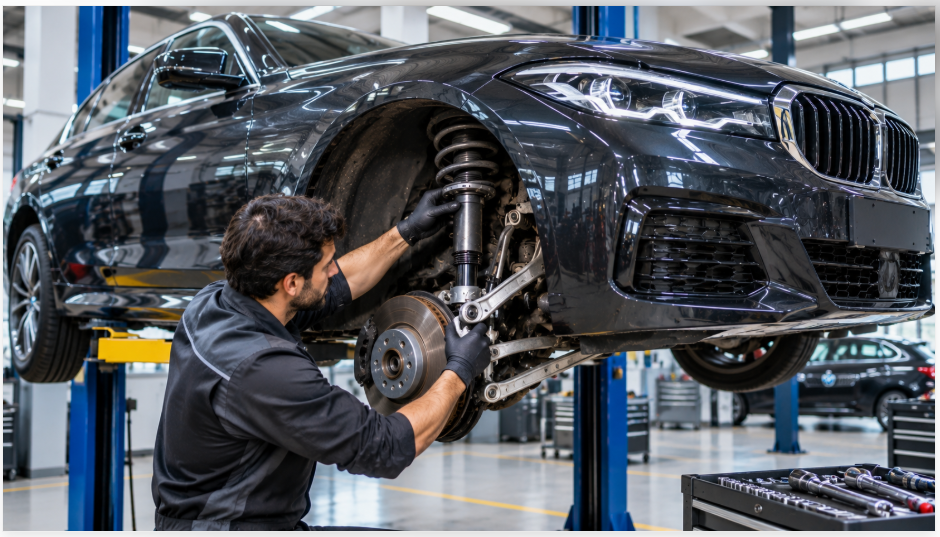

BMW Suspension Service & Maintenance Repair
Looking for reliable BMW suspension repair in Dubai? German Auto Lab.ae provides professional BMW suspension inspection, diagnostics, repair, and maintenance services for different BMW models.
Whether your BMW has unusual suspension noises, excessive bouncing, uneven ride height, steering problems, or an air suspension warning, our technicians can inspect the vehicle, identify the cause, and recommend suitable repairs.
Your BMW's suspension system helps absorb road bumps, maintain tyre contact, and provide better handling, stability, and driving comfort.
We focus on accurate diagnostics, quality workmanship, and suitable repair solutions to help keep your BMW safe and comfortable on the road.
BMW Suspension Repair for All Models
Signs Your BMW May Need Suspension Repair
- Rough or bumpy ride over normal road surfaces
- Excessive bouncing after hitting a bump
- Car pulling to one side under braking or acceleration
- Uneven tyre wear across front or rear axles
- Knocking, rattling, or unusual suspension noises
- Steering feels loose, vague, or difficult to turn
- Oil leaking from shock absorbers or active struts
- One side of the vehicle sits lower than the other
- Excessive body movement or roll when turning
- Suspension or chassis warning messages on iDrive display
- Vehicle height adjustment problems or air compressor failure
Common BMW Suspension Issues
1. Shock Absorber Problems
Shock absorbers control excessive vehicle movement and help maintain tyre contact with the road. Worn shock absorbers can reduce driving comfort and affect vehicle stability. Common signs include excessive bouncing, rough or uncomfortable ride, poor handling, and oil leaks around the shock absorbers.
2. Control Arm and Bushing Problems
Control arms and bushes connect the suspension system to the vehicle's chassis. Worn or damaged bushes (especially BMW hydraulic tension strut bushings) can affect wheel positioning and steering stability. Common signs include clunking noises over bumps, steering vibration under braking, uneven tyre wear, and loose steering response.
3. Suspension Spring Problems
Suspension springs support the vehicle's weight and absorb road impacts. Broken or weakened coil springs can affect ride height and vehicle stability. Common signs include one side of the vehicle sitting lower, uneven ride height, unusual suspension noises, and reduced driving comfort.
4. Ball Joint and Stabilizer Link Problems
Ball joints and stabilizer sway bar links help maintain proper suspension movement and lateral stability. Common signs include knocking noises, steering vibration, excessive body roll when cornering, and poor handling when turning.
5. Air Suspension Problems
Some BMW models (such as 5 Series Touring, 7 Series, X5, and X7) are equipped with air suspension systems that automatically adjust vehicle height and maintain ride comfort. Common signs include vehicle sitting lower than normal, uneven vehicle height, air suspension warning messages, compressor running continuously, and vehicle unable to raise or lower properly. Possible causes include damaged air springs, air leaks, faulty compressors, and defective height sensors.
6. Electronic Damper Control (EDC) Problems
BMW Electronic Damper Control adjusts shock absorber damping according to driving conditions. Faulty sensors, wiring, dampers, or control units can affect the system's operation. Common signs include suspension warning messages, unusually stiff or soft ride, reduced driving comfort, and electronic damping system malfunction.
7. Ride Height Sensor Problems
Ride height sensors monitor the vehicle's suspension height and send information to the suspension control system. Common signs include incorrect vehicle height readings, uneven suspension height, chassis warning messages, and air suspension adjustment problems.
Common BMW Suspension Fault Codes and Their Meanings
BMW vehicles use electronic suspension systems to monitor ride height, shock absorber performance, damping control, and air suspension operation. When the system detects a problem, it stores a diagnostic trouble code (DTC):
| Fault Code | General Description |
|---|---|
| 0x030C5A | Ride height sensor reading is implausible (Front Left) |
| 0x030C5B | Ride height sensor reading is implausible (Front Right) |
| 0x030C5C | Ride height sensor reading is implausible (Rear Left) |
| 0x030C5D | Ride height sensor reading is implausible (Rear Right) |
| 480E2F | Air suspension compressor overheating |
| 480E29 | Air suspension compressor maximum operating time exceeded |
| 480E6D | Vehicle lift detected by the electronic ride height control system |
| 37140202 | Electronic Damper Control (EDC) internal fault |
| 37140279 | Electronic Damper Control connection problem |
| 37140280 | Electronic Damper Control short circuit |
| 37140614 | Ride height sensor occasional malfunction |
| 37140615 | Ride height sensor permanent malfunction |
| 37140637 | Ride height sensor loose |
| 37140679 | Ride height sensor connection problem |
| 37140802 | Single-axle air suspension control unit (EHC) internal fault |
| 37140880 | Single-axle air suspension control unit (EHC) short circuit |
| 37140902 | Two-axle air suspension control unit (EHC) internal fault |
| 37140980 | Two-axle air suspension control unit (EHC) short circuit |
The exact interpretation of BMW-specific fault codes can vary depending on the vehicle model, suspension configuration, control module, and diagnostic software.
BMW Suspension Control Module Diagnostics, Repair and Programming
The suspension control system manages electronic suspension functions, including ride height adjustment, damping control, and air suspension operation. Depending on the BMW model, these functions may be managed by different control modules, such as: Electronic Damper Control (EDC), Electronic Ride Height Control (EHC), Vertical Dynamics Platform (VDP), and Vertical Dynamics Management (VDM).
Signs of a Faulty BMW Suspension Control Module
- Suspension warning lights on instrument cluster
- Chassis malfunction and Drive Moderately warnings on iDrive display
- Incorrect vehicle ride height
- Air suspension not adjusting properly or compressor locked out
- Electronic damping system failure
- Unusually stiff or soft suspension response
- Communication problems with diagnostic equipment
- Repeated suspension-related fault codes
BMW Suspension Control Module Repair and Programming Services
German Auto Lab.ae can help diagnose BMW electronic suspension control problems through vehicle diagnostics and system testing. Depending on the fault, the required service may include: BMW EDC control module diagnostics, EHC control unit inspection, VDP and VDM system diagnostics, suspension module communication testing, wiring and electrical connection inspection, suspension sensor testing, control module coding and programming, suspension control module repair assessment, and control module replacement and programming where required. Engine Control Module (ECM/DME) Communication: The engine control module is separate from the suspension control system. However, BMW suspension modules may receive vehicle information from the DME/DDE. For example, fault D71482 can indicate that the EHC module has not received drivetrain data from the engine control module. Not every suspension fault code means the control module is damaged. Faulty sensors, wiring problems, low battery voltage, communication interruptions, and software issues can also trigger these codes. Proper testing is necessary before recommending module repair or replacement.
Our BMW Suspension Repair Services
Why Choose German Auto Lab.ae for BMW Suspension Repair?
Choosing a reliable workshop is important when dealing with BMW suspension problems. At German Auto Lab.ae, we focus on: professional BMW suspension inspection and diagnostics, identifying worn or damaged suspension components, electronic suspension system diagnostics, repair solutions based on the actual problem, service for different BMW models and suspension types, suitable replacement parts for the required repair, clear explanations and repair recommendations, customer approval before additional work, transparent pricing, and free pickup and delivery across Dubai. Our goal is to help you maintain your BMW's comfort, performance, and road stability.
Frequently Asked Questions
1. How much does BMW suspension repair cost in Dubai?
The cost depends on the BMW model, suspension type, nature of the problem, and replacement parts required. An inspection is necessary before providing an accurate repair estimate.
2. What are the most common BMW suspension problems?
Common problems include worn shock absorbers, damaged suspension springs, worn control arm bushes, faulty ball joints, air suspension leaks, compressor failures, and electronic suspension sensor problems.
3. What are the common BMW suspension fault codes?
Some commonly encountered codes include 0x030C5A, 0x030C5B, 480E2F, and 480E29. Other BMW-specific codes may indicate EDC, EHC, ride height sensor, and suspension control module problems.
4. What are the symptoms of a faulty BMW suspension control module?
Symptoms may include suspension warning lights, incorrect ride height, electronic damping failure, air suspension adjustment problems, and repeated communication fault codes. Proper diagnostics are needed to confirm whether the module requires repair or replacement.
5. Can BMW air suspension be repaired?
Yes. Depending on the problem, repairs may involve replacing damaged air springs, fixing air leaks, repairing the compressor, or replacing faulty ride height sensors and valves.
6. How often should BMW suspension be checked?
It is recommended to have the suspension inspected during regular vehicle maintenance or whenever you notice changes in driving comfort, steering, vehicle height, or tyre wear.
7. Can damaged BMW suspension affect tyre wear?
Yes. Worn suspension components can affect wheel alignment and cause uneven tyre wear. Replacing damaged components and checking wheel alignment can help address the problem.
8. Do you provide suspension repair for all BMW models?
We provide suspension inspection and repair services for different BMW models, including 1–8 Series, X Series, Z Series, M Models, and applicable i Models. Service availability depends on the vehicle and suspension configuration.
9. Can I still drive my BMW with a suspension warning light?
It depends on the warning and the vehicle's condition. If the vehicle is leaning, unstable, has significantly reduced ground clearance, or shows a serious chassis warning, avoid driving and arrange a professional inspection.
10. Can a BMW suspension control module be repaired?
Some BMW suspension control module problems can be repaired or reprogrammed, depending on the nature of the fault. However, certain internal electronic failures may require module replacement and coding.